Crooked or Gapped Teeth
Move the teeth, or reshape the ones that show. Here is what is usually going on, how each treatment fixes it, and how to choose between them.
- treatments to weigh, from the smallest fix to the most durable
- 3
- new patient exam and x-rays to find out which one fits
- $99
- patient comfort is the number one priority
- Nothing in pain
What’s going on?
Sometimes it is the whole smile: teeth that bunch up and overlap because there was never quite enough room. Sometimes it is one thing: a gap between the two front teeth, or a single tooth turned or sitting out of line. Sometimes it is a bite where the top and bottom teeth do not meet the way they should. Whatever you notice first, it is rarely only about looks. Crowded teeth trap food and are harder to floss, so cavities and gum trouble find them sooner. Teeth that sit out of line take uneven wear, and a bite that does not close properly puts strain where it should not be.
Which fix is right comes down to a few questions. Do the teeth actually need to move, or do they only need to look straighter? Is it one tooth or several? And is the bite part of the problem, or is it only the front teeth you see in photos? Invisalign moves the teeth themselves. Veneers and bonding reshape what shows without moving anything. Dr. Bhoompalli works through those questions at your consultation. She looks at your bite and your gum health as well as the teeth you want to change, and tells you plainly which option fits.

Sound familiar?
Book a consultation
Move the teeth, or reshape the ones that show
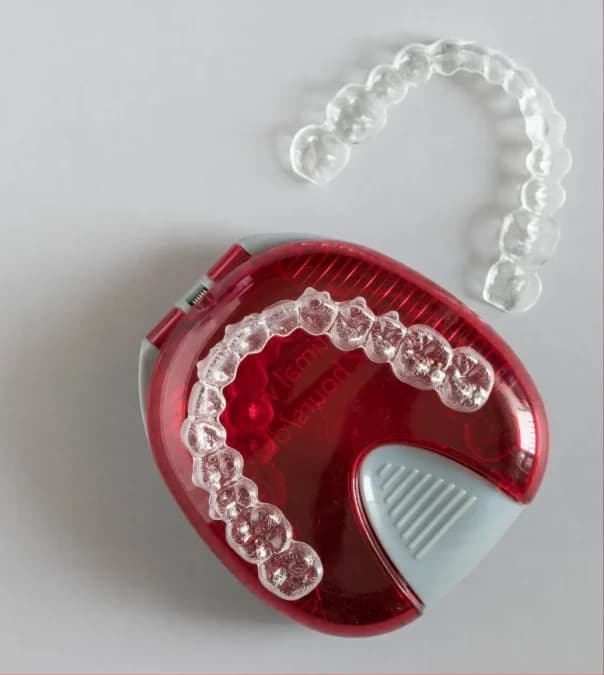
Invisalign is the answer when the teeth need to move. A series of clear, removable aligner trays shifts them a small, planned amount at a time. It handles most crowding, spacing, and mild to moderate bite problems in teens and adults. It is the right choice whenever the bite is part of the picture. Treatment starts with a scan or impressions, and Dr. Bhoompalli, who has advanced Invisalign training, maps every stage before the first tray is made. You may feel gentle pressure for a day or two with each new set, and that is all.
Dental veneers take a different route. Thin, custom-made shells, usually porcelain, are bonded to the front of the teeth and change their color, shape, and length in one step. For mildly crowded, rotated, or uneven front teeth, that can make the line look straight without moving a single tooth. A small gap can be closed by widening the neighboring teeth slightly. The trade is that a thin layer of enamel comes off so the veneer sits flush. That is why we talk through Invisalign or bonding first when one of those would get you there. If the crowding is significant or the bite is off, veneers are not asked to do a job orthodontics does better.
Dental bonding is the smallest fix of the three. Tooth-colored resin is sculpted directly onto the tooth. It can close a small to moderate gap, even out one uneven edge, or build out a tooth that is narrower than its neighbors. It is done in a single visit. Little or no enamel is removed, and in most cases no numbing is needed. Because so little is taken from the tooth, bonding can be polished away, redone, or upgraded to a veneer later without harm. A wide gap or one caused by a bite problem is usually better handled with Invisalign, and we will tell you that at the exam.
Time, cost, and what lasts
Invisalign asks for the most time and gives back the most complete result, because the teeth end up where they belong. Most cases finish in 12 to 18 months, and mild crowding or spacing is often quicker. The trays must be worn 20 to 22 hours a day to work, with check-ins every few weeks. Treatment typically runs $3,000 to $8,000 depending on length, and many dental plans cover it the way they cover braces. Cases started in September are $1,500 off. Retainers afterward are what keep the result. If you are weighing aligners against wires, Invisalign or braces lays the two out side by side.
Veneers are faster to the finish line. Porcelain usually takes two visits a few weeks apart and typically lasts 10 to 15 years. Composite is finished in one visit and lasts closer to 5 to 7 years. Porcelain runs $1,000 to $2,500 per tooth and composite $300 to $1,000, and insurance usually treats veneers as cosmetic. Bonding is the quickest and least expensive route, typically $300 to $600 per tooth in a single appointment. It lasts several years with good care. Resin can chip on ice or fingernails and can dull slightly over time, but it is simple to touch up. For one tooth or a small gap, veneers or bonding is the comparison worth reading.
None of these are permanent-and-forgotten. Veneers and bonded teeth are brushed and flossed like any other, kept away from hard candy and pen caps, and polished at your six-month cleanings. If you grind at night, a custom night guard protects the work. Invisalign trades that for nightly retainer wear once treatment is done. What the consultation settles is whether your teeth need to move and how many are involved. It also settles whether the bite will support a cosmetic fix or undo it. The veneer consultation is free, and whichever route you choose, nothing here is done in pain. We go over insurance, financing, and the in-house membership plan before anything starts.
The treatments we reach for.
Listed from the smallest fix up. Your exam decides which actually fits your mouth, your budget, and your patience.
Book a consultation Where to start
Invisalign
Straightens the teeth themselves with clear aligners, the right answer when the bite is part of the problem.
Option 2Dental Veneers
For mild crowding or a small gap on front teeth, veneers can even the line without moving anything.
Option 3Dental Bonding
Closes a small gap or evens one uneven edge in a single appointment.
Where to next?
Common question
Invisalign or braces: which fits your daily routine?
Compare Invisalign and fixed braces by daily responsibilities and treatment goals before your Johns Creek consultation.
Read the answer
Common question
Veneers or bonding: which fits the change you want?
Compare veneers and bonding by tooth preparation, repairability, appearance, and bite requirements.
Read the answer
Related concern
Chipped or Worn Front Teeth
Rebuild an edge, from a quick fix to a full cover
Explore the concern
Bring the Concern.
Leave With a Plan.
Prefer to talk? Call 770-814-7600 during office hours.
Medically reviewed by Dr. Madhavi Bhoompalli, DDS, dentist and owner at Johns Creek Family Dentistry. Last reviewed September 2026. This page is for education and is not a substitute for an examination by a licensed dentist.